3 Questions With… Stan Yan
I initially became aware of Stan and his work through Kids Comics Unite. I began following him on various social media sites. I was impressed by his prolificness and variety of work with multiple regular comic strips. And I love his enthusiasm for the comics medium, sharing and teaching his knowledge to up-and-coming creators.
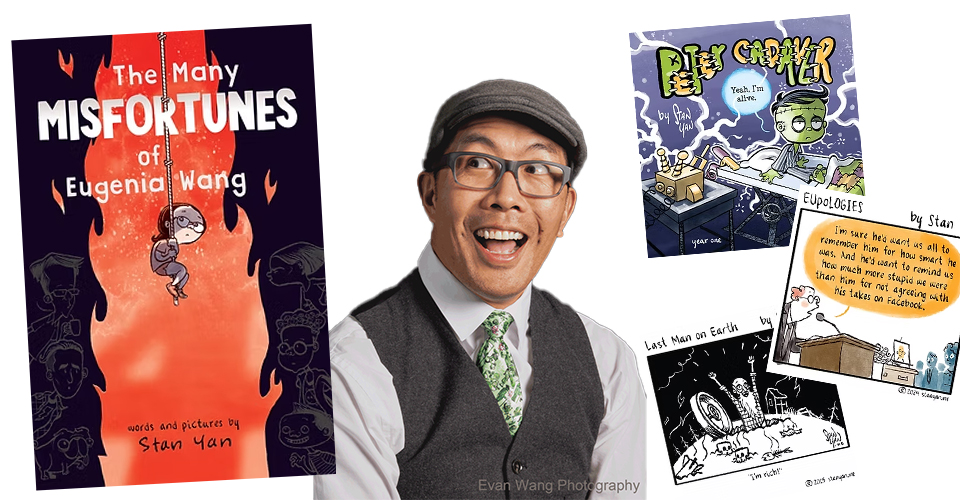
His latest work, The Many Misfortunes of Eugenia Wang has really got me excited. A girl born on a day considered unlucky in Chinese superstition starts to wonder if she really is cursed when she’s troubled by visions of doom set to occur on her thirteenth birthday.
It comes out September 30th and has already racked up a number of glowing reviews and is a Junior Library Guild selection.
Why comics? (What compels you to create in this medium?)
Comics has always been my muse. My earliest memory of holding a pencil involved me drawing the same stick figure over and over again in boxes that I later discovered were called panel borders: I was DOING comics before I realized it! And I’ve always seen stories in my head as sequential images, so it’s definitely a preference and something that has come very intuitively to me. So, you’d think it would come very naturally for me to teach it (and I have done so in kids summer camps and after school programs as well as in higher ed and currently via the CuddlefishAcademy.com), but I had to reverse engineer my process to figure it out with the help of my mentor Tom Motley (who trained me to take over his summer camps when he moved to NYC to teach at SVA and Pratt), and books by Scott McCloud and Jessica Abel & Matt Madden. My background with teaching kids comics explains why so much of how I teach involves a great deal of gameplay, which I hope is fun and engaging.
What is something you do now that you wish you had either figured out or implemented sooner in your career?
Two things: I wish I had figured out that I wanted to create comics for kids a lot sooner. But that would’ve probably required that we had a kid a lot sooner than we did (and we probably couldn’t have afforded it), because it was he that changed my story inspirations and caused my pivot into kidlit. Prior to that, I had no real interest in creating for children, even though I was teaching them my craft. Certainly part of that was because, thanks to the resources and offerings through the SCBWI I learned that there was a clearer path to publication in traditional children’s publishing (albeit still extremely competitive) than in the comic book industry. And they actually paid advances on royalties so we could live during the creation process. That being said, I do feel like REALLY I didn’t become published sooner than I should have, because I don’t think I had the technology, knowledge and experience with the technology, nor the skills to meet the incredibly fast deadlines required in this industry until very recently.
Secondly, I wish I had figured out that I had PERMISSION to make protagonists in my stories that looked like me. My first self published picture book, THERE’S A ZOMBIE IN THE BASEMENT features a character that is actually named after my son, but when I designed the character, I reflexively designed him as a red-headed white kid. I never even considered making him look like my son or myself. But, then I started to read books by Chinese-American creators, like Andrea Wang, Grace Lin, Lisa Yee, and Kelly Yang which made me start questioning myself: Why did I not make my protagonist look like me? As I reflected on my childhood, the only book I read in the school library I can remember having Chinese characters was THE FIVE CHINESE BROTHERS, and it didn’t make me particularly proud of being Chinese. The problem was representation, and I began to fear that in not making my character look like me, I might be perpetuating the problem with another generation of readers who might become creators that didn’t feel like they had permission to create characters that look like themselves. That’s why it was so very important for me to not only redesign my main character in the latest edition of my picture book, but also why Eugenia Wang is Eugenia Wang.
What has (pleasantly) surprised you about creating comics that you didn’t anticipate when you first started out?
When I started, I had no illusions of doing this for a career. Most of my early self-published comics were created as entertainment for my friends, featuring characters loosely based on them and their families. When I started hearing from strangers that enjoyed reading my photocopied and saddle stitched books, THAT was what made making comics addictive. So, every step of my comics life has been me trying to reach a larger and larger reading audience of stranger who I can affect in some way, whether it’s making them laugh, scaring them, or just making them think. It has literally been a 50+ year pursuit of my passions that have brought me here.
You can find Stan online at: